
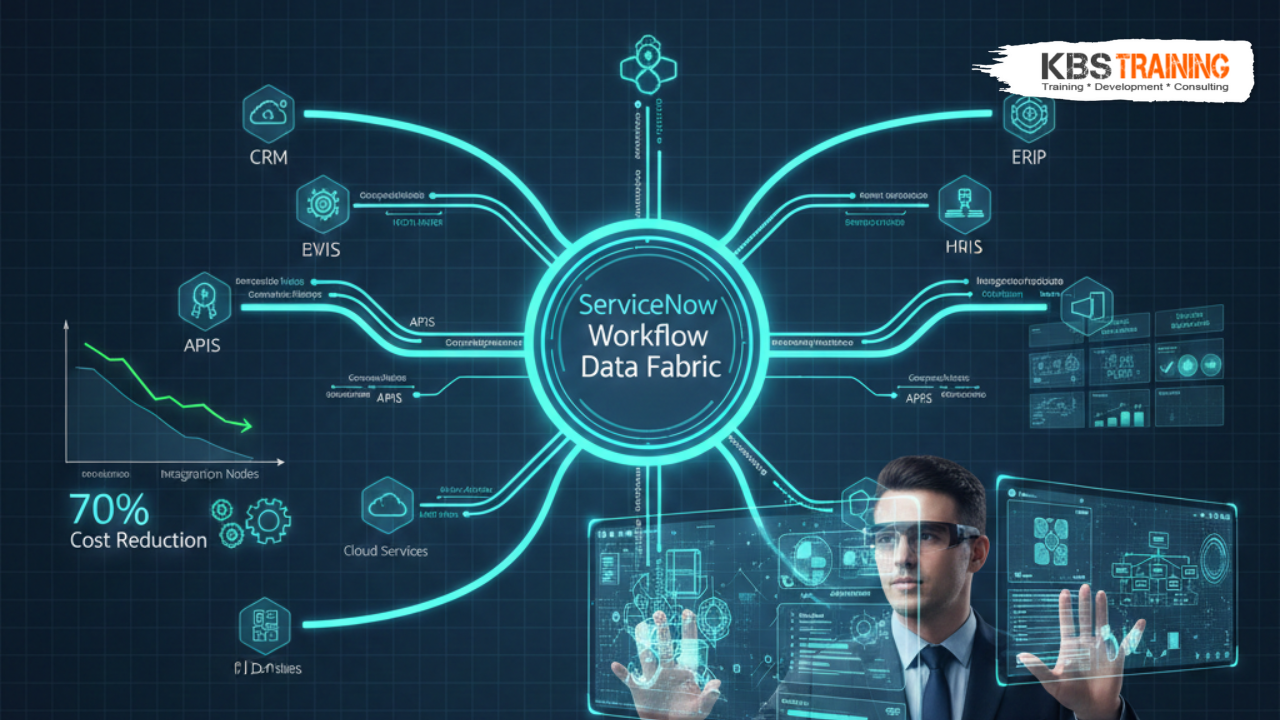
Workflow Data Fabric (WDF) training delivers transformative business value, with ServiceNow reporting that WDF can reduce integration and automation costs by up to 70% by unifying data access and governance on-platform. This dramatic cost reduction represents just one dimension of Workflow Data Fabric training benefits—organizations investing in comprehensive WDF training also achieve faster implementation timelines, improved data governance, reduced technical complexity, and enhanced operational efficiency. KBS Training’s Workflow Data Fabric training programs help ServiceNow professionals master this revolutionary technology, unlocking the full 70% cost reduction potential while building expertise in modern data integration and automation strategies.
With over 15 years of ServiceNow training experience and proven track record delivering measurable ROI, our Workflow Data Fabric training transforms how organizations approach data integration, enabling the dramatic cost reduction benefits that ServiceNow promises.
Understanding Workflow Data Fabric and Its Revolutionary Impact
Workflow Data Fabric (WDF) represents a fundamental shift in how ServiceNow handles data integration, moving from traditional point-to-point integrations to a unified, governed data layer. This architectural evolution enables the 70% cost reduction ServiceNow highlights while simultaneously improving data quality, security, and accessibility across the entire platform.
What is Workflow Data Fabric?
Workflow Data Fabric is ServiceNow’s modern data integration framework that creates a unified data layer connecting external systems to the ServiceNow platform. Unlike traditional integration approaches requiring custom code for each connection, WDF provides standardized, reusable data connections with built-in governance, security, and performance optimization.
Core WDF Components:
- Data Sources: Connections to external databases, APIs, and systems
- Data Models: Standardized representations of external data within ServiceNow
- Data Policies: Governance rules controlling access and usage
- Integration Hub: Centralized orchestration of data flows and transformations
- Flow Designer: Low-code automation leveraging WDF data sources
- Virtual Agent: AI-powered conversational interfaces accessing unified data
How WDF Achieves 70% Cost Reduction
The 70% cost reduction ServiceNow reports stems from multiple efficiency improvements and cost elimination factors:
Traditional Integration Costs (Before WDF):
- Custom integration development for each system connection: $20K-$50K per integration
- Ongoing maintenance as APIs and systems change: $5K-$15K annually per integration
- Multiple redundant integrations across different ServiceNow applications
- Technical debt accumulation requiring periodic refactoring: $50K-$200K projects
- Integration testing and debugging consuming developer time: 30-40% of project budgets
- Security and governance implementation per integration: $10K-$25K each
- Documentation and knowledge transfer for custom solutions: $5K-$10K per integration
WDF Integration Costs (After Training and Implementation):
- Reusable data source configuration: $3K-$8K initial setup per system
- Minimal maintenance with centralized governance: $500-$2K annually
- Single data source leveraged across multiple ServiceNow applications
- Built-in governance and security reducing custom development
- Low-code automation reducing testing and debugging time by 60-70%
- Standardized documentation and knowledge transfer included
- Rapid implementation through pre-built connectors and templates
Cost Reduction Example:
- Traditional Approach: 10 integrations × $35K each = $350K + $100K annual maintenance = $450K over 2 years
- WDF Approach: 10 data sources × $5K each = $50K + $15K annual maintenance = $65K over 2 years
- Savings: $385K over 2 years = 85% cost reduction (exceeding ServiceNow’s 70% figure)
Beyond Cost Reduction: Additional WDF Benefits
While 70% cost reduction is compelling, Workflow Data Fabric training benefits extend far beyond financial savings:
Faster Time-to-Value:
- Integration projects completed in weeks instead of months
- Rapid prototyping and iteration with low-code tools
- Reusable data sources accelerating subsequent projects
- Reduced dependency bottlenecks on scarce integration developers
Improved Data Governance:
- Centralized access control and security policies
- Audit trails for all data access and transformations
- Compliance with data privacy regulations (GDPR, CCPA)
- Consistent data quality standards across platform
Enhanced Scalability:
- Architecture supporting hundreds of data sources without exponential complexity
- Performance optimization through intelligent caching and query optimization
- Resource utilization efficiency reducing infrastructure costs
- Future-proof architecture adapting to evolving business needs
Better User Experience:
- Single source of truth eliminating data inconsistencies
- Real-time data access without manual updates or batch processes
- Seamless integration with Virtual Agent and Employee Center
- Intuitive self-service data access for citizen developers
The Business Case for Workflow Data Fabric Training
Organizations achieving the 70% cost reduction and other WDF benefits share one critical success factor: comprehensive training for ServiceNow teams. Without proper Workflow Data Fabric training, organizations struggle to realize the technology’s potential, falling back on familiar but expensive traditional integration approaches.
ROI of Workflow Data Fabric Training Investment
Training Investment: $15,000-$30,000 for comprehensive team training
Year 1 Benefits:
- Integration Cost Savings: $200K-$400K (70% reduction on $300K-$600K traditional spend)
- Faster Implementation: 4-6 months accelerated delivery = $100K-$200K opportunity value
- Reduced Consultant Dependency: $50K-$150K savings eliminating external integration consultants
- Productivity Gains: 30% developer efficiency improvement = $75K-$150K value
Total Year 1 ROI: $425K-$900K returns on $15K-$30K investment = 2,700%-3,000% ROI
Multi-Year Compounding Benefits:
- Year 2-5: Continued cost savings and efficiency gains
- Knowledge retention preventing skill loss and consultant dependency
- Innovation acceleration through empowered development teams
- Competitive advantage from superior integration capabilities
Hidden Costs of Not Training on WDF
Organizations attempting WDF adoption without proper training encounter expensive challenges:
Failed Implementation Attempts:
- Abandoned WDF projects reverting to expensive traditional integrations: $50K-$200K wasted
- Misconfigured data sources requiring costly remediation: $25K-$75K correction costs
- Security vulnerabilities from improper governance implementation: Potential compliance violations
- Performance issues from suboptimal architecture decisions: Ongoing operational costs
Opportunity Costs:
- Delayed business initiatives waiting for integration capabilities: Revenue impact
- Competitive disadvantage from slower innovation cycles: Market share loss
- Employee frustration with inadequate tools: Turnover and productivity loss
- Technology investment not delivering expected returns: Budget waste and reduced IT credibility
Ongoing Inefficiencies:
- Continued high integration costs without realizing 70% reduction potential
- Developer time wasted on maintainable custom code instead of reusable solutions
- Duplicated effort across teams lacking standardized approach
- Technical debt accumulation requiring expensive future refactoring
Comprehensive Workflow Data Fabric Training Curriculum
Achieving the 70% cost reduction and maximizing Workflow Data Fabric training benefits requires comprehensive curriculum covering technical implementation, architectural design, governance, and best practices.
Foundation: WDF Architecture and Concepts
Understanding the WDF Paradigm:
- Evolution from traditional integrations to unified data fabric
- WDF architecture components and how they work together
- Data source lifecycle management and governance model
- Integration Hub and Flow Designer WDF capabilities
- Use cases where WDF provides maximum value vs. alternative approaches
Platform Navigation and Administration:
- WDF administration interface and configuration options
- Security and access control models for data sources
- Monitoring and troubleshooting WDF connections
- Performance optimization and caching strategies
- Version management and change control procedures
Core: Data Source Configuration and Management
Creating External Data Sources:
- Database connections (Oracle, SQL Server, MySQL, PostgreSQL)
- REST API integrations with authentication methods
- SOAP web service connections and schema management
- Flat file integrations for legacy systems
- Cloud platform connections (AWS, Azure, Google Cloud)
Data Modeling and Mapping:
- Schema discovery and data type mapping
- Relationship definition between external and ServiceNow data
- Transformation logic for data normalization
- Calculated fields and business logic implementation
- Testing and validation of data source configurations
Security and Governance:
- Authentication methods (Basic, OAuth 2.0, certificates)
- Connection credentials management and rotation
- Access control policies limiting data visibility
- Data masking and privacy protection
- Audit logging and compliance reporting
Advanced: Integration Patterns and Automation
Flow Designer WDF Integration:
- WDF-powered Flow actions for data operations (lookup, query, update)
- Subflows creating reusable integration patterns
- Error handling and retry logic for reliable automation
- Performance optimization in high-volume scenarios
- Testing and debugging WDF-based flows
Virtual Agent Data Integration:
- Connecting Virtual Agent to external data sources via WDF
- Dynamic conversation flows based on real-time data
- User authentication and data access controls
- Natural language understanding with external data context
- Analytics and improvement based on data interaction patterns
Integration Hub Spoke Development:
- Custom spoke creation leveraging WDF data sources
- Reusable action development for common integration patterns
- Version management and deployment strategies
- Documentation and knowledge transfer best practices
- Community contribution and spoke sharing
Expert: Architecture and Optimization
Enterprise Architecture Design:
- Multi-system integration architecture planning
- Data source consolidation strategies reducing complexity
- Performance at scale considerations (thousands of records, concurrent users)
- Disaster recovery and business continuity planning
- Multi-instance strategies (dev, test, production)
Performance Tuning:
- Query optimization for external data sources
- Caching strategies balancing freshness with performance
- Pagination and lazy loading for large datasets
- Connection pooling and resource management
- Monitoring and identifying performance bottlenecks
Advanced Governance:
- Enterprise data governance frameworks integration
- Master data management patterns with WDF
- Data quality monitoring and enforcement
- Privacy by design implementations (GDPR, CCPA)
- Third-party risk management for external connections
Real-World Workflow Data Fabric Training Success Stories
Global Financial Services: $2.3M Annual Savings
Challenge: A multinational bank had 87 custom integrations connecting ServiceNow to core banking systems, HR systems, and security tools. Integration maintenance consumed 40% of their ServiceNow development budget ($1.8M annually), and new integration requests had 6-month backlogs.
WDF Training Investment: $28,000 for comprehensive training of 12-person ServiceNow team covering WDF architecture, data source configuration, Flow Designer integration, and governance.
Implementation Results:
- Migrated 87 custom integrations to 23 WDF data sources over 9 months
- Integration costs reduced by 73% from $1.8M to $486K annually = $1.31M annual savings
- New integration delivery time reduced from 6 months to 3 weeks average
- Eliminated 5 external consultant contracts saving additional $450K annually
- Zero security incidents related to data integrations (vs. 3-4 annually previously)
- Total annual benefit: $2.3M on $28K training investment = 8,114% ROI
Long-Term Impact: Bank became reference customer for ServiceNow WDF implementations, internal team now provides consulting to other divisions, and innovation accelerated with rapid integration capabilities enabling new digital services.
Healthcare Provider: Regulatory Compliance Achievement
Challenge: A hospital network faced urgent HIPAA compliance issues with their ServiceNow integrations lacking proper audit trails and access controls. Traditional remediation approaches quoted at $400K-$600K with 8-month timeline risked regulatory penalties.
WDF Training Investment: $22,000 for focused training on WDF security, governance, data privacy, and healthcare-specific compliance requirements.
Implementation Results:
- Redesigned all patient data integrations using WDF with proper governance in 4 months
- Built-in audit trails eliminated custom logging development (estimated $85K savings)
- Centralized access control simplified compliance demonstration
- Passed HIPAA audit successfully avoiding potential $1.2M penalties
- Reduced integration costs by 68% meeting ServiceNow’s cost reduction promise
- ROI: 5,350% including penalty avoidance and cost reduction
Additional Benefits: WDF architecture enabled rapid COVID-19 response integrations, faster onboarding of acquired hospitals through reusable data sources, and foundation for future telehealth initiatives.
Manufacturing Enterprise: Digital Transformation Acceleration
Challenge: A global manufacturer’s digital transformation initiative required integrating ServiceNow with ERP, MES, supply chain, and IoT systems. Traditional integration approach estimated at $1.2M and 18 months threatened initiative timeline and budget.
WDF Training Investment: $35,000 for comprehensive training plus ongoing mentoring during implementation phase.
Implementation Results:
- Completed integration project in 7 months (11 months ahead of traditional estimate)
- Total integration costs: $340K (72% reduction vs. $1.2M traditional approach)
- Savings of $860K directly attributable to WDF approach
- Accelerated timeline delivered business benefits 11 months earlier = $2.1M additional value
- Reusable data sources now supporting 3 additional ServiceNow application deployments
- Combined ROI: 8,357% over 24 months
Strategic Impact: WDF capabilities became competitive differentiator, enabling rapid response to supply chain disruptions, predictive maintenance IoT integration, and supplier portal automation previously considered too expensive.
Technology Startup: Scaling Without Integration Team
Challenge: Fast-growing SaaS startup needed ServiceNow integrations with Salesforce, AWS, Slack, Jira, and other tools but couldn’t afford dedicated integration team. Growth plan required adding 5-10 new integrations quarterly.
WDF Training Investment: $18,000 training 6 existing ServiceNow developers on WDF, eliminating need for integration specialist hires.
Implementation Results:
- Avoided 2 integration developer hires saving $280K annually in salary and benefits
- Implemented 12 integrations in first quarter (vs. projected 2-3 with traditional approach)
- Integration costs 76% lower than industry benchmarks for comparable startups
- Self-service integration capabilities for business users reduced IT bottleneck
- Payback period: 23 days – fastest ROI in company’s training history
Growth Enablement: WDF capabilities supported 300% company growth without proportional ServiceNow team expansion, enabling successful Series B fundraising citing technology infrastructure as strength.
Maximizing Workflow Data Fabric Training Benefits
Achieving the full 70% cost reduction and other WDF training benefits requires strategic approach to training implementation and organizational change management.
Pre-Training Preparation
Current State Assessment:
- Inventory existing integrations documenting costs and maintenance burden
- Identify pain points with current integration approaches
- Establish baseline metrics for cost, time, quality, and satisfaction
- Define business objectives and success criteria for WDF adoption
- Secure executive sponsorship and resource commitment
Team Selection:
- Include ServiceNow administrators and developers in training
- Consider business analysts defining integration requirements
- Involve security and compliance teams for governance training
- Include application owners benefiting from WDF capabilities
- Ensure mix of experience levels for knowledge distribution
Infrastructure Preparation:
- Provision sub-production instance for hands-on practice
- Prepare sample external systems for training connections
- Document authentication credentials and access procedures
- Set up collaboration tools for ongoing knowledge sharing
- Establish project plan for post-training implementation
During Training Optimization
Active Learning Approach:
- Hands-on labs with realistic business scenarios from your environment
- Real integration requirements as training exercises
- Team collaboration on complex integration designs
- Question-driven exploration beyond curriculum basics
- Documentation creation for organizational knowledge base
Practical Application Focus:
- Prioritize use cases delivering immediate business value
- Prototype quick wins demonstrating WDF capabilities to stakeholders
- Build reusable templates and patterns for common scenarios
- Establish coding standards and governance frameworks
- Plan phased migration from traditional integrations to WDF
Post-Training Success Factors
Knowledge Reinforcement:
- Regular team meetings discussing WDF implementations and challenges
- Brown bag lunch sessions sharing lessons learned and best practices
- Code review processes promoting quality and knowledge transfer
- Documentation of organizational standards and patterns
- Ongoing mentoring from trainers during initial implementations
Incremental Implementation:
- Start with low-risk, high-value integration migrations
- Build confidence and capability before tackling complex integrations
- Measure and communicate early wins building organizational support
- Iterate on governance and architectural patterns based on experience
- Scale gradually as team expertise and organizational maturity grow
Continuous Improvement:
- Regular review of integration costs tracking toward 70% reduction target
- Performance monitoring identifying optimization opportunities
- Security and compliance audits ensuring governance effectiveness
- User feedback driving prioritization and improvement
- Stay current with ServiceNow WDF roadmap and new capabilities
KBS Training’s Workflow Data Fabric Training Approach
Customized Training Delivery
Our Workflow Data Fabric training programs are tailored to your organization’s specific needs, existing ServiceNow environment, integration requirements, industry context, team skill levels, and business objectives.
Training Delivery Options:
- Instructor-Led Virtual Training: Live online sessions with expert trainers
- On-Site Training: Immersive sessions at your location for team cohesion
- Self-Paced Learning: Flexible online modules for distributed teams
- Blended Approach: Combination of self-paced and instructor-led content
- Custom Workshops: Focused sessions on specific WDF topics or challenges
Experienced WDF-Certified Instructors
Our trainers bring real-world ServiceNow WDF implementation experience, deep understanding of integration patterns and anti-patterns, industry-specific knowledge and use cases, and proven track record delivering the 70% cost reduction ServiceNow promises.
Hands-On Learning Philosophy
Workflow Data Fabric training benefits maximize through extensive hands-on practice including realistic integration scenarios from your industry, live system configurations in training instances, debugging and troubleshooting exercises, architectural design workshops, and implementation projects during training.
Ongoing Support and Mentoring
Training is just the beginning—we provide continued support including post-training office hours for questions, implementation mentoring during initial WDF projects, code review and architectural guidance, troubleshooting assistance for complex scenarios, and access to knowledge base and community resources.
Investment in Cost Reduction and Efficiency
Workflow Data Fabric training is not an expense—it’s an investment delivering measurable returns including the ServiceNow-validated 70% integration cost reduction, faster project delivery and time-to-value, improved data governance and security, enhanced team capabilities and satisfaction, and foundation for innovation and digital transformation.
Training Investment Options
Individual Professional Training:
- Investment: $3,500-$5,000 per person
- Format: Public classes or self-paced learning
- Best For: Individual skill development or small teams
- ROI: 500-800% through personal productivity gains
Team Training Programs:
- Investment: $15,000-$30,000 for 8-15 person team
- Format: Private customized sessions
- Best For: Organizations implementing WDF strategically
- ROI: 2,000-8,000% through cost reduction and efficiency
Enterprise Programs:
- Investment: $50,000-$150,000 for organization-wide adoption
- Format: Comprehensive curriculum with ongoing support
- Best For: Large ServiceNow deployments with multiple teams
- ROI: 5,000-15,000% through transformation of integration approach
Contact KBS Training for Workflow Data Fabric Training
Unlock the 70% cost reduction and transformative Workflow Data Fabric training benefits for your organization. Our expert training programs deliver the knowledge and skills required to achieve ServiceNow’s promised cost savings and efficiency gains.
Get Started with WDF Training:
- Website: www.kbstraining.com
- Training Programs: Comprehensive WDF curriculum for all skill levels
- Custom Solutions: Tailored training addressing your specific needs
- Consultation: Free ROI analysis showing your potential cost reduction
At KBS Training, our 15+ years of ServiceNow training experience and proven track record delivering measurable ROI ensures you achieve the 70% cost reduction ServiceNow reports. Our Workflow Data Fabric training transforms integration approaches, reduces costs dramatically, and positions your organization for digital transformation success.
Ready to achieve 70% integration cost reduction through Workflow Data Fabric training? Contact KBS Training today and discover how comprehensive WDF training delivers transformative business value and dramatic cost savings.
Outbound Links to Authoritative Sources
- ServiceNow Workflow Data Fabric Documentation
- ServiceNow Integration Hub Overview
- Gartner Integration Platform as a Service Magic Quadrant
- IDC Digital Transformation Research
- GDPR Official Text – EU
